Cheese, milk and cream: pasteurise, make, press and pack.
Every block, jug and carton checked and coded right.
totalMOS runs a dairy plant from the vat to the cold room: milk, cream, cultures and salt weighed out against the make sheet, pack weight, fat, moisture and pH checked on time at the line, the phosphatase test and product temperature on the record, and every failed reading taken to closure.
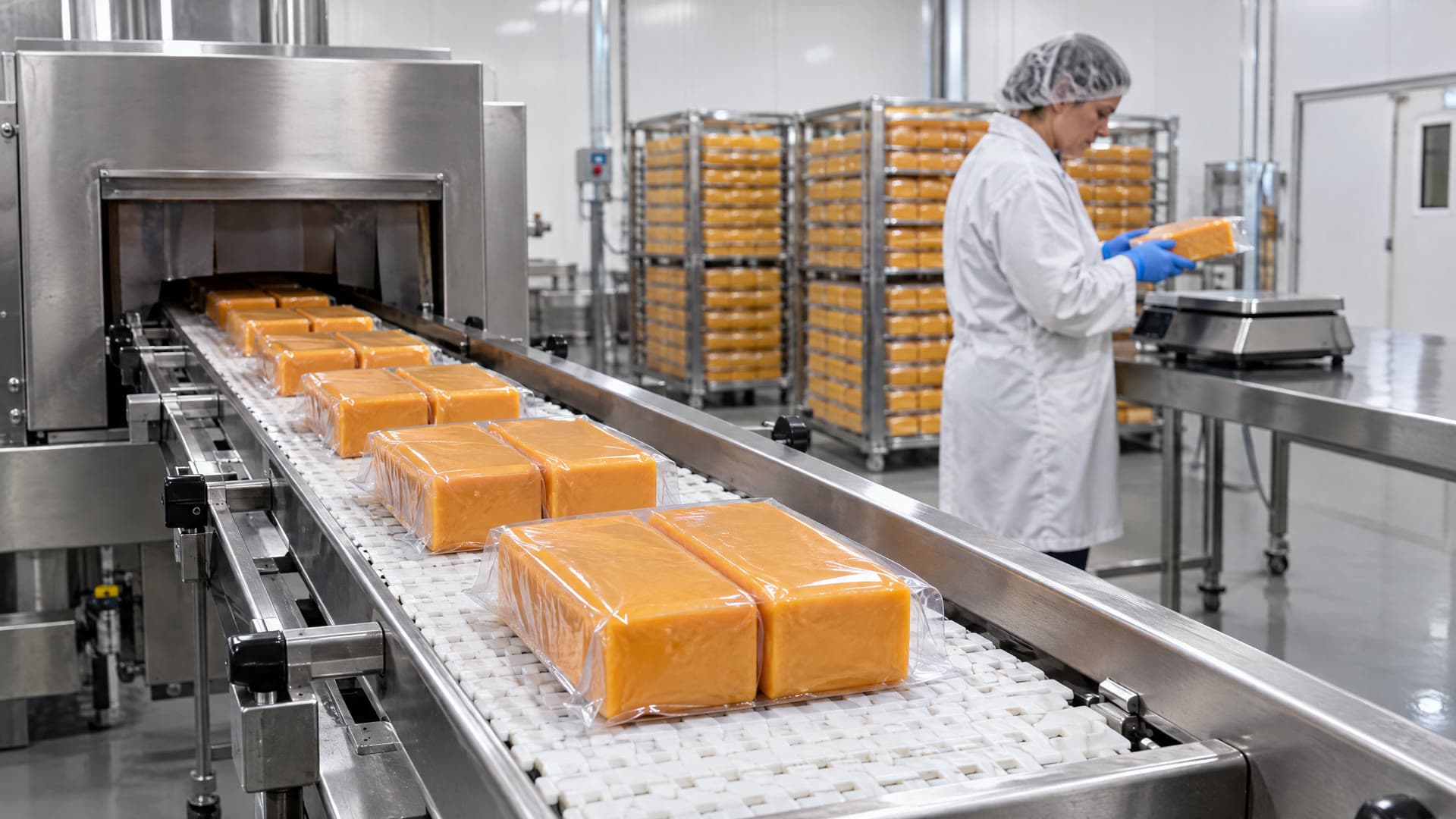
Where a dairy line loses product
Moisture is money
A cheddar a point too wet fails its standard, and a point too dry gives yield away on every vat. Neither shows on a paper log until the lab results come back days later.
The cold chain breaks quietly
A pallet of milk left at the dock or a cheese packed warm looks fine at the end of the line and spoils before its best-before. The temperature check that catches it has to happen on time, every time, not when someone remembers.
Pasteurised has to be proven
A negative phosphatase test is the proof the milk was pasteurised. When it lives on a clipboard, nobody can show which vat it covered or who read it.
How totalMOS runs a dairy line
Weight, temperature and seal at the line
Pack net weight, product temperature and seal integrity each count down on the iPad at the line, with moisture, fat, pH and salt on their own clocks. Every reading is judged against that product’s limits the moment it is typed.
Every vat weighed out against its formula
A batch order turns the product’s formula into the kilograms of milk, cream, culture, rennet and salt for a cheese, or of milk, sugar and cocoa for a chocolate milk. Two people sign the sheet, and it keeps the formula it was struck from.
A failed seal holds the blocks
An out-of-spec reading opens a non-conformity before the check can close. The hold is counted in packs, blocks, cases or pallets, the AQL disposition is recorded, and the corrective action sits on the same record.
Giveaway and defects, by line
The weight curve of every production order shows its pack weights against the target, and the Pareto shows which line and which defect type drive the out-of-spec readings.
The checks on the line
The demo dairy plant ships with the checks a cheese and milk line runs, from pack weight to grading score. Your own tests, limits and frequencies replace them.
- 50 products, each with its own limits
- Holds counted in cases, pallets, blocks, or packs
| Check | Default spec | Sample | Frequency |
|---|---|---|---|
| Pack net weightWeight curve10 samples · Every hour | 196-208 g · average ≥ 200 g | 10 samples | Every hour |
| Moisture content3 samples · Every 4 h | 34-39 % | 3 samples | Every 4 h |
| Fat content3 samples · Every 4 h | 31-35 % | 3 samples | Every 4 h |
| pH3 samples · Every 2 h | 5-5.4 pH | 3 samples | Every 2 h |
| Salt content3 samples · Every 4 h | 1.4-1.9 % | 3 samples | Every 4 h |
| Phosphatase test1 sample · Every 2 h | Pass | 1 sample | Every 2 h |
| Product temperature3 samples · Every hour | 0-4 °C | 3 samples | Every hour |
| Seal integrity10 samples · Every hour | Pass | 10 samples | Every hour |
| Cheese colour3 samples · Every 4 h | Orange | 3 samples | Every 4 h |
| Grading score1 sample · Every 8 h | 88-100 points | 1 sample | Every 8 h |
| Metal detection1 sample · Every 30 min | Pass | 1 sample | Every 30 min |
| Make date1 sample · Every 2 h | The day of the check | 1 sample | Every 2 h |
| Date code1 sample · Every 2 h | Best-before, counted from the shelf life | 1 sample | Every 2 h |
Frequently asked questions
Can it check the make date and the best-before on the same pack?
Yes. Make date is a manufacture-date check that must carry the day of the check, and the date code is a best-before counted from the product’s shelf life, twelve months for a cheddar and eighteen days for a milk in the demo plant. A coder set to the wrong date fails on the first reading.
Does it handle grading and colour checks?
Yes. A check can be a number, a pass or fail, or a choice from a list. Grading score is a number with a minimum, and cheese colour is a choice where only some colours pass: orange for a cheddar, white or ivory for a mozzarella.
Can cheese and milk run in the same plant?
Yes. Every product carries its own limits, so a 2% milk and an old cheddar have their own fat band, and a check that does not apply to a product, like moisture on a milk, is left off it rather than failing on every run.
What happens when the Wi-Fi drops in the cold room?
Nothing is lost. The reading is kept on the iPad with the time it was taken and sent the moment the connection returns, and the record keeps both times.
Other industries
See it with your own cheeses.
Thirty minutes, with your products, formulas and specs set up before the call.
Book a demo