Skincare and colour: compound, homogenise, fill and carton.
Every batch to its formula, every tube to its weight.
totalMOS runs a cosmetics plant from the compounding vessel to the cartoner: the formula weighed out and signed, pH, viscosity and shade checked against the spec, fill weight on time at the filler, and every non-conformity taken through hold, disposition and corrective action.
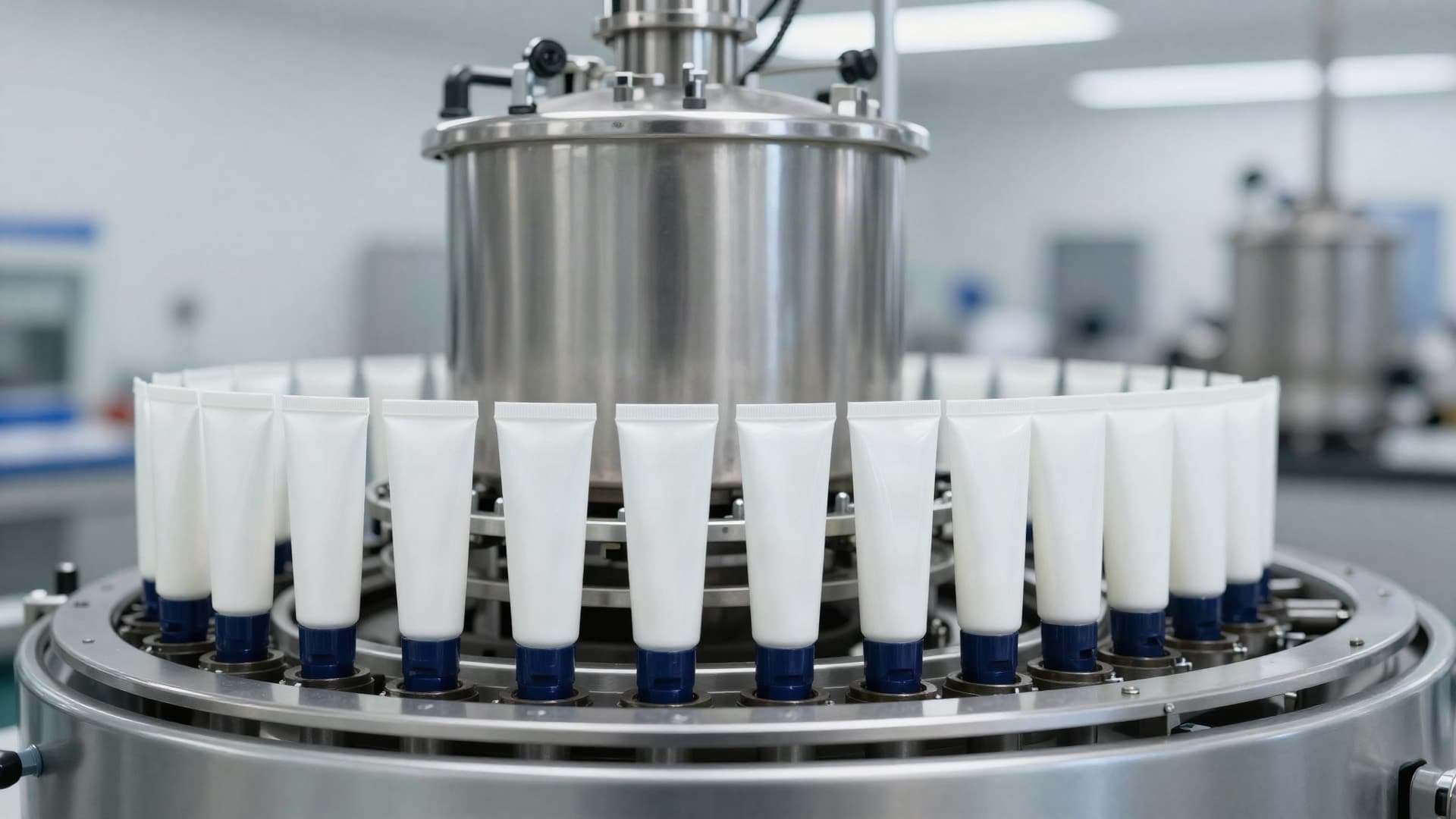
Where a cosmetics line loses product
The formula is the product
A serum is its formula, to the gram. When the weigh-out is a printed sheet and a pen, a revised formula and last month’s batch record can disagree, and nobody can say which one was made.
Fill weight cuts both ways
A tube under its declared content is a compliance problem, and a tube a few grams over is product given away on every unit. Neither shows until somebody adds up the clipboard.
Shade and stability are judgement calls
Shade match, odour and phase stability are read by eye, and a tick on paper cannot be checked by anyone afterwards. The record has to say what was seen, by whom and when.
How totalMOS runs a cosmetics line
pH, viscosity and shade on the record
Fill weight counts down at the filler, with pH, viscosity, specific gravity and shade match on their own clocks. Judgement checks are a choice from a list, such as on standard or slight variation, so the record says what was seen.
The formula, weighed out and signed by two
A batch order turns the formula into the kilograms of every raw material for the vessel. Two people sign before anything is tipped in, and the sheet keeps the formula it was struck from.
Holds counted in trays and cases
An out-of-spec reading opens a non-conformity before the check can close. The hold is counted in units, trays, cases or pallets, the AQL disposition is recorded with its scanned plan, and a CAPA follows the defect to its root cause.
Giveaway and defects, by filler
The weight curve of every production order shows its fill weights against the target, and the Pareto shows which filler and which defect type drive the out-of-spec readings.
The checks on the line
The demo cosmetics plant ships with the checks a filling line runs, from fill weight to the microbial swab. Your own tests, limits and frequencies replace them.
- 50 products, each with its own limits
- Holds counted in cases, pallets, trays, or units
| Check | Default spec | Sample | Frequency |
|---|---|---|---|
| Fill weightWeight curve10 samples · Every hour | 50-52.5 g | 10 samples | Every hour |
| pH3 samples · Every 2 h | 4.5-5.5 pH | 3 samples | Every 2 h |
| Viscosity3 samples · Every 4 h | 8,000-14,000 cP | 3 samples | Every 4 h |
| Specific gravity3 samples · Every 4 h | 0.98-1.02 g/mL | 3 samples | Every 4 h |
| Shade match5 samples · Every 2 h | On standard, Slight variation | 5 samples | Every 2 h |
| Odour3 samples · Every 4 h | True to standard | 3 samples | Every 4 h |
| Phase stability3 samples · Every 2 h | Pass | 3 samples | Every 2 h |
| Grittiness3 samples · Every 4 h | Pass | 3 samples | Every 4 h |
| Microbial swab1 sample · Every 8 h | Pass | 1 sample | Every 8 h |
| Cap torque5 samples · Every 2 h | 8-14 lbf·in | 5 samples | Every 2 h |
| Batch code and artwork5 samples · Every 2 h | Pass | 5 samples | Every 2 h |
| Manufacture date1 sample · Every 3 h | The day of the check | 1 sample | Every 3 h |
| Date code1 sample · Every 3 h | Best-before, counted from the shelf life | 1 sample | Every 3 h |
Frequently asked questions
Can every shade have its own spec?
Yes. Each shade is its own product with its own limits, so a foundation range carries a shade standard for each shade while sharing the checks that are the same.
Does it check the batch code and artwork?
Yes. Batch code and artwork is a pass-or-fail check at the line, the manufacture date must carry the day of the check, and the best-before is counted from the product’s shelf life, thirty months in the demo plant.
Can a check be left off an anhydrous product?
Yes. A lip balm has no water, so pH, viscosity and phase stability are left off it instead of failing on every run. Each product carries only the checks that apply.
Who can see the formulas?
Batching is a closed door: only batchers and admins open batch orders. Managers, operators and mechanics do not, however senior, and every gate is enforced by the API rather than only hidden on screen.
Other industries
See it with your own formulas.
Thirty minutes, with your products, formulas and specs set up before the call.
Book a demo